Use case·Privacy and networking
Running a Tor exit relay
on a VPS in Panama City.
Run a Tor exit node VPS in Panama City: reduced exit policy, exit notice on port 80, tor-exit rDNS, complaint handling.
- Tor
PTY1·Panama City
In stockRecommended for this use case
- 1 Gbps port20 TB of transfer a monthIncluded
- Debian 13preinstalled with the orderIncluded
- DDoS protection, 1 IPv4VNC console and full rootIncluded
Optional: daily backups +20% · extra IPv4 $2 · priority support $10
Pay yearly: $206.99 a year, about 25% less
- No KYC
- Crypto only
- Panama jurisdiction
- 6 vCPU, 8 GB RAM
- 320 GB NVMe local storage
- 20 TB transfer on a 1 Gbps port
- DDoS protection included
- Panamanian law
01/07
Why exits get turned
away elsewhere.
The large clouds settled the question in their acceptable-use policies some time ago. DigitalOcean's AUP, last updated on 20 March 2026, lists Tor exit nodes among the prohibited network services, next to open proxies, open mail relays and open recursive resolvers. Vultr told a relay operator in September 2022 that it does not support any Tor-related activity on its network, exits included, and the Tor Project's community wiki has recorded exits there as not permitted under Vultr's AUP since 2024. OVHcloud's support, in a reply reproduced on the same wiki, called running an exit "strictly forbidden" and named suspension or termination of the account as the consequence. The wiki lists AWS as relay-yes, exit-no, and anyone who has seen an AWS egress bill knows the bandwidth would end the experiment before the policy did.
The hosts that tolerate exits usually attach a tripwire. Linode, according to a 2021 report on the wiki, accepts exits only with a reduced exit policy. Hetzner's position as reported there is that an exit is not a problem in itself but that abuse reports can get the server locked, which for an exit is a question of when rather than whether. Further down the market the pattern repeats: AlexHost in Moldova forbids exits, Gcore suspends services once abuse mail arrives, and Swiss Made Host does not want Tor on its network in any form. These are dated user reports, some several years old, so read the current terms before you buy anything, ours included.
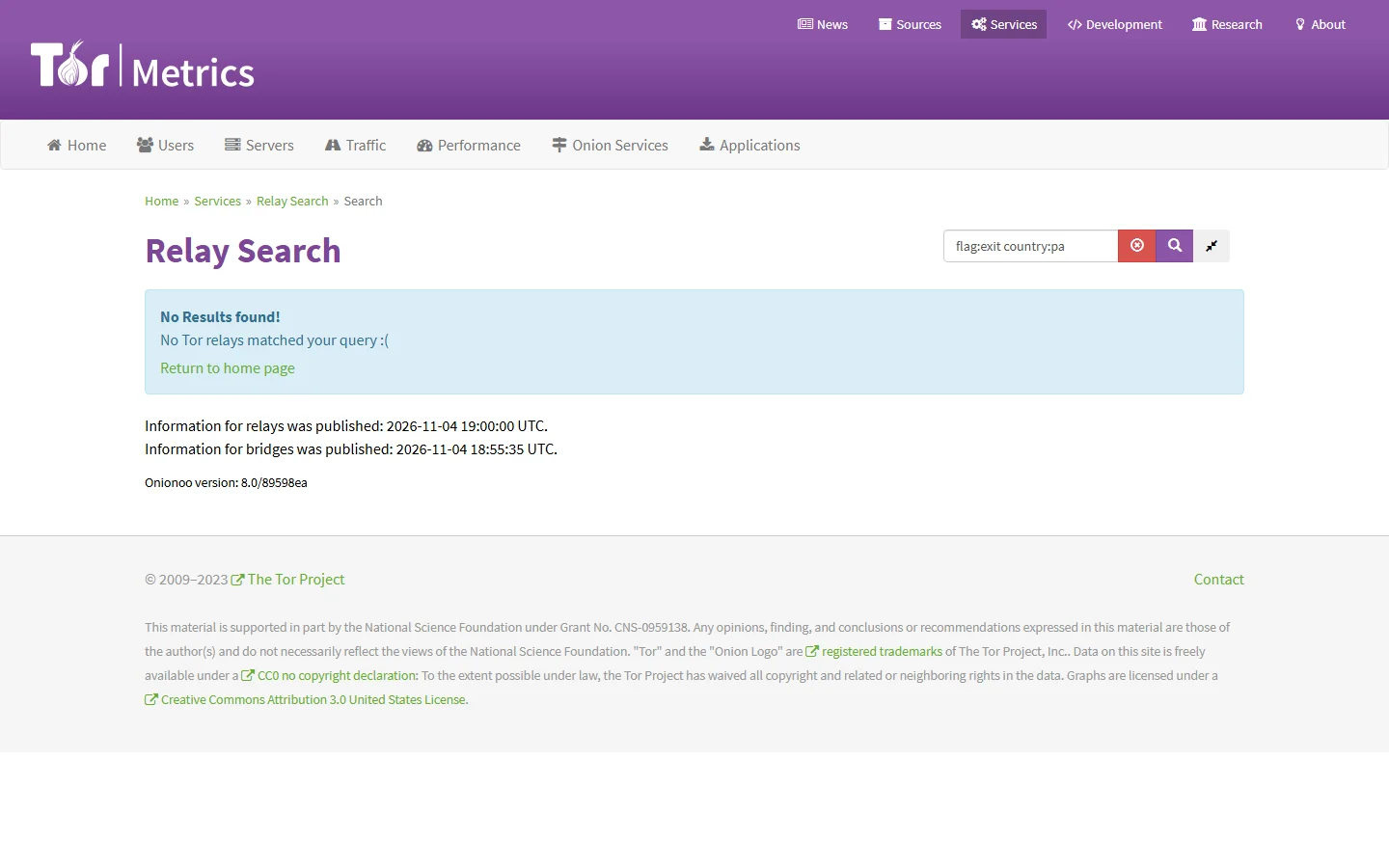
The second problem has nothing to do with policy. The wiki opens with a list of hosts to avoid because they already carry too much of the network (OVH, Hetzner, Scaleway, IONOS and netcup among them), and the exit guidelines say plainly that pooling exits at one friendly ISP does not help anyone. The Good/Bad ISPs page has no Panama section at all; its only Central American entry is a Costa Rican provider last updated in 2022. An exit in PTY1 therefore adds a country and an autonomous system that path selection rarely sees. How rarely, in a number rather than an adjective: on 4 November 2026, Relay Search on Tor Metrics returned no exit relay located in Panama, from relay data published at 19:00 UTC that day.
02/07
What Panamanian law changes,
and what it does not.
The first practical difference is copyright mail. A DMCA notice has no legal effect on servers in Panama. We forward copyright complaints to the customer and act on a decision of a competent Panamanian authority, or where the content is manifestly unlawful. An exit relay forwards traffic and stores no content, so in practice a forwarded notice is answered with one of the standard Tor replies and closed. The reduced exit policy also keeps most BitTorrent traffic off the relay, and BitTorrent is where most copyright complaints against exits originate. Our general handling of copyright mail is described in our page on DMCA notices.
The second is the route a request has to take. Article 29 of Panama's Constitution allows private communications to be intercepted or recorded only on the order of a judicial authority. A US agency cannot write to us with legal force directly: Panama and the United States cooperate through a mutual legal assistance treaty in force since 6 September 1995, and as of 31 October 2026 the US Department of Justice lists CLOUD Act executive agreements with the United Kingdom and Australia only. That is a procedure, not an immunity, and we will not dress it up as one. Panama acceded to the Budapest Convention on Cybercrime in March 2014, and in October 2024 its National Assembly amended the Criminal Code, the Code of Criminal Procedure and Law 11 of 2015 on international legal assistance to align them with the Convention. Preservation and production orders for traffic data can reach Panama, and Panamanian courts can execute them.
For an exit operator this is less alarming than it reads, because the relay has very little to hand over. An exit sees the destination of a connection and never the client behind it, and the Tor Project runs ExoneraTor so that anyone, a prosecutor included, can check whether an address was an exit at a given moment. The answer to most enquiries is a link to that page and a short letter. Law 51 of 2009, which obliges telecommunications companies and other networks that provide or sell communication services to keep certain user data for six months, is a separate question: whether it reaches a hosting provider is a matter for Panamanian counsel, and we do not claim to have settled it.
What we cannot offer yet is a published legal opinion on exit relaying under Panamanian law. The Tor Project's exit guidelines cite carrier-liability provisions for the United States and Germany and nothing for Panama. Two things do not move with the server. Your own country's law still applies to you as a person, and an operator's duties are the same in PTY1 as anywhere else: keep the notice and the PTR record accurate, answer complaints, and keep the exit address free of anything that is not Tor. The wider jurisdictional picture is on our offshore hosting page.
Our servers are in Panama City and answer to Panamanian law. A US DMCA notice has no legal effect here, and we act only on valid orders from competent Panamanian authorities.
03/07
Sizing an exit.
An exit has no "users" in the hosting sense. It has throughput, concurrent connections and DNS lookups, and the Tor Project publishes requirements for all three. The table maps a target throughput to those requirements and to a machine. Traffic figures are theoretical: sustained load for 30 days, computed as Mbit/s ÷ 8 × 2,592,000 seconds. Real exits do not run flat out around the clock.
| Target exit throughput | tor instances | RAM (Tor Project guidance) | Theoretical traffic per direction, 30 days | Machine in PTY1 |
|---|---|---|---|---|
| 16–25 Mbit/s | 1 | ≥ 1.5 GB | 5.2–8.1 TB | VPS Pro, 20 TB of monthly transfer, with the BandwidthRate cap below |
| 25–50 Mbit/s | 1 | ≥ 1.5 GB | 8.1–16.2 TB | VPS Power, 40 TB of monthly transfer, capped the same way |
| 50–400 Mbit/s | 1, expect ~100,000 concurrent connections above 100 Mbit/s | ≥ 1.5 GB | 16.2–129.6 TB | Dedicated server, 10 Gbps port, unmetered traffic |
| 400–900 Mbit/s | 2 | ≥ 3 GB | 129.6–291.6 TB | Dedicated server |
| above 1 Gbit/s | 3 or more, maximum 8 per IPv4 address | 1.5 GB per instance | above 324 TB | Dedicated server |
Storage hardly matters: tor keeps less than 200 MB of state. CPU matters per core rather than in total, because each tor instance does most of its work on a single thread. That is why operators who outgrow one instance add a second process on the same machine instead of buying a faster CPU, and why the 400 Mbit/s line in the table is a process limit rather than a network one. At the bottom end, the Tor Project's floor for any relay is 10 Mbit/s (16 recommended) and 100 GB of traffic a month; below that, a bridge is a better use of the machine.
Transfer decides between the two: each VPS plan includes a fixed monthly volume, and an exit sends roughly what it receives, so the first two rows keep both directions together inside the 20 TB of VPS Pro and the 40 TB of VPS Power. A dedicated server's traffic is unmetered under fair use, which is why everything above 50 Mbit/s goes there.
04/07
Architecture.
One VPS, one job. The exit runs tor and a local resolver and nothing else; the only thing that leaves the box on purpose, apart from relayed traffic, is an encrypted copy of the relay's identity keys.
The resolver sits on the machine because an exit resolves hostnames on behalf of its clients, and the Tor Project asks operators not to send those lookups to Google, Cloudflare, Quad9 or OpenDNS. Unbound with DNSSEC validation and QNAME minimisation, no forwarders, is the standard answer. The guidance also asks that the resolver not send queries from an address used by a relay, since exit addresses end up on blocklists and a blocked resolver degrades every circuit using the exit.
Object storage earns a place for one reason. The keys in /var/lib/tor/keys are the relay's identity: they carry its fingerprint, its measured history and its family membership, and losing them means starting over as an unknown relay. Encrypt the archive on the server before it goes anywhere. A CDN has no role here; putting one in front of an exit makes no sense, and tor serves the exit notice itself.
05/07
Deployment on
Debian 13.
The commands below follow the Tor Project's documented procedure for Debian, adapted to Debian 13 (trixie).
- 01
1. Order and set reverse DNS
Order VPS Pro with Debian 13 from the deploy page. Before tor exits a single packet, point the PTR record of the exit address at a name on a domain you own, for example
tor-exit-1.example.org, and never attorproject.org. Confirm that the CPU reports AES-NI and that the architecture is supported by the Tor repository:grep -m1 -o aes /proc/cpuinfo dpkg --print-architecture # must print amd64 or arm64 - 02
2. Install tor from the Tor Project repository
Debian's own tor package lags behind the stable release, so the Tor Project recommends its repository. Its instructions still list
apt-transport-https, which apt has not needed since version 1.5; it is left out here.sudo apt update sudo apt install -y gnupg wget ca-certificates wget -qO- https://deb.torproject.org/torproject.org/A3C4F0F979CAA22CDBA8F512EE8CBC9E886DDD89.asc \ | gpg --dearmor | sudo tee /usr/share/keyrings/deb.torproject.org-keyring.gpg >/dev/null sudo tee /etc/apt/sources.list.d/tor.sources >/dev/null <<'EOF' Types: deb deb-src URIs: https://deb.torproject.org/torproject.org/ Suites: trixie Components: main Signed-By: /usr/share/keyrings/deb.torproject.org-keyring.gpg EOF sudo apt update sudo apt install -y tor deb.torproject.org-keyring - 03
3. Run a local caching resolver
Check
ls -l /etc/resolv.conffirst. If it is a symlink into systemd-resolved, disable that service and remove the link before writing the file, orchattrwill fail.sudo apt install -y unbound sudo cp /etc/resolv.conf /etc/resolv.conf.backup echo "nameserver 127.0.0.1" | sudo tee /etc/resolv.conf sudo chattr +i /etc/resolv.conf sudo systemctl enable --now unbound getent hosts torproject.org # should return addresses via 127.0.0.1Recent unbound versions enable
qname-minimisationby default and validate DNSSEC out of the box. If you have a second IPv4 address, send resolver traffic from it (203.0.113.11 is a documentation address; use yours):printf 'server:\n outgoing-interface: 203.0.113.11\n' \ | sudo tee /etc/unbound/unbound.conf.d/outgoing.conf sudo systemctl restart unbound - 04
4. Publish the exit notice
sudo wget -qO /etc/tor/tor-exit-notice.html \
  https://gitlab.torproject.org/tpo/core/tor/-/raw/main/contrib/operator-tools/tor-exit-notice.html
sudo nano /etc/tor/tor-exit-notice.html   # replace every FIXME placeholder
Replace each placeholder with your own details, and add a line saying the relay runs in Panama City with a working abuse address. Whoever lands on that page is usually an administrator reading a log line at 3 a.m.; give them what they need to stop worrying.
- 05
5. Write the torrc
The
ExitPolicylines are evaluated first and prepended to the reduced policy, which already rejects port 25; the explicit line is there so that anyone auditing the file sees that SMTP is closed without looking up the tor manual. The reduced policy does accept IRC (194, 6660–6669, 6679, 6697); we suggest closing those ports as well, hence the four rejects.sudo tee /etc/tor/torrc >/dev/null <<'EOF' Nickname PTYexit01 ContactInfo email:abuse[]example.org url:https://example.org ciissversion:2 ORPort 443 DirPort 80 DirPortFrontPage /etc/tor/tor-exit-notice.html SocksPort 0 ExitRelay 1 # No SMTP, no IRC. Prepended to the reduced exit policy. ExitPolicy reject *:25 ExitPolicy reject *:194 ExitPolicy reject *:6660-6669 ExitPolicy reject *:6679 ExitPolicy reject *:6697 ReducedExitPolicy 1 # IPv6Exit 1 # only with a routed IPv6 address that has its own tor-exit PTR # VPS Pro only: average ceiling inside the 20 TB of monthly transfer BandwidthRate 3 MBytes BandwidthBurst 6 MBytes MetricsPort 127.0.0.1:9035 MetricsPortPolicy accept 127.0.0.1 EOF sudo tor --defaults-torrc /usr/share/tor/tor-service-defaults-torrc \ -f /etc/tor/torrc --verify-configBandwidthRatecaps the average in each direction. Tor counts in powers of two, so 3 MBytes a second is about 25 Mbit/s: at most 8.4 TB each way in a 31-day month, 16.9 TB in both directions together, under the 20 TB included with VPS Pro however the allowance is counted. On VPS Power, use 6 and 12 MBytes; on a dedicated server, leave both lines out.DirPorthas been deprecated since tor 0.4.6.5 for its original purpose, but it still serves theDirPortFrontPagenotice, which is the only reason it is here. If you run more than one relay, every one of them must declare the others withMyFamily, so clients never pick two of your relays for the same circuit. Above roughly 100 Mbit/s, watch thetor_relay_exit_dns_error_total{reason="timeout"}counter on the metrics port: DNS timeouts are the most common way an exit quietly underperforms. - 06
6. Start and verify
sudo systemctl restart tor@default
sudo journalctl -u tor@default -f
curl -s http://YOUR.EXIT.IP/ | head -n 5
Wait for the log line confirming that the ORPort is reachable from outside, then look the relay up on Relay Search at metrics.torproject.org after a few hours and check that the exit policy summary shows what you intended. A new relay takes time to be measured and weighted; low traffic in the first days is normal.
- 07
7. Keep it patched and keep the keys
Install
unattended-upgradesandapt-listchanges, then allow both Debian security and the Tor repository as origins in/etc/apt/apt.conf.d/50unattended-upgrades:Unattended-Upgrade::Origins-Pattern { "origin=Debian,codename=${distro_codename},label=Debian-Security"; "origin=TorProject"; };For the key backup, encrypt on the server and upload the result with any S3 client:
sudo tar -C /var/lib/tor -czf - keys \
  | gpg --symmetric --cipher-algo AES256 -o tor-keys-$(date +%F).tar.gz.gpg
06/07
Monthly cost.
Three worked cases, all from catalogue prices. A VPS Pro capped at about 25 Mbit/s moves up to 8.1 TB a month in each direction, roughly 2.84 USD per terabyte sent; an Iron dedicated server at a sustained 400 Mbit/s moves about 129.6 TB each way for 64.99 USD, roughly 0.50 USD per terabyte. Both figures are theoretical: 30 days at that rate.
| Scenario | What runs | Monthly | Yearly |
|---|---|---|---|
| A. First exit | 1 × VPS Pro, one exit instance | 22.99 USD | 275.88 USD |
| B. Declared family | 2 × VPS Pro, two exits with MyFamily | 45.98 USD | 551.76 USD |
| C. Association | 1 × Iron dedicated server, several exit instances | 64.99 USD | 779.88 USD |
Scenario A is where most first-time exit operators should start: one instance, a reduced policy, and a month of complaint traffic to learn from before adding anything. Scenario B buys capacity and a second machine for maintenance windows, but not diversity, since both relays share a country, an AS and our abuse desk. A second address for the resolver costs 2.00 USD a month. Scenario C moves to a dedicated server: one machine, several instances, unmetered traffic, and up to eight relays on one IPv4 address. Current figures for every plan are on the pricing page.
Payment follows our usual terms. Sign-up is no-KYC, so an email address is enough to open an account, and we accept business customers paying in crypto, which suits associations that already hold their donations that way. Prepaid top-ups carry a bonus, and the unused balance is refundable within 14 days. Our no-KYC hosting page explains what we do and do not ask for.
07/07
Limits and acceptable
use.
Our acceptable use policy welcomes Tor exit nodes and sets no conditions of its own for them; what follows is our advice for an exit that lasts. Use the reduced exit policy with the IRC ports and port 25 rejected: port 25 is open on every VPS for your own mail, and an exit that relays SMTP draws spam complaints to your address. Serve an exit notice on port 80, give the address a PTR record containing tor-exit, and use it for Tor and nothing else: no websites, no VPN endpoint, no mail server on the same address. Name an abuse contact in ContactInfo and on the notice page, and read it.
Complaints work like this. Abuse reports concerning the exit address reach you in a support ticket, with time to answer or fix the problem unless the harm is ongoing and serious, as our acceptable use policy sets out. Copyright notices follow the rule stated above: forwarded, with action only on a decision of a competent Panamanian authority or where content is manifestly unlawful, which for a relay that hosts nothing is hard to imagine. The Tor Abuse Templates and the Torservers.net replies cover nearly every case; the Tor Project says it is rare to meet a complaint none of them fits. To reach us about an exit, open a support ticket from the client panel.
Suspension is the step the acceptable use policy takes when a use clearly breaks it, and running an exit is a use it welcomes. Relays and bridges without exiting need none of the advice above, since non-exits do not attract complaints. Before you commit, it is worth posting your plan on the tor-relays mailing list.
Catalogue·Options
Every configuration, every option, every price.
Six cloud VPS plans on AMD EPYC with local NVMe. Transfer is included on every plan, from 10 TB to 100 TB a month.
| Plan | vCPU | Memory | NVMe | Transfer | Port | Price | Deploy |
|---|---|---|---|---|---|---|---|
| StarterStaging, dev | 2 | 2 GB | 80 GB | 10 TB / month | 1 Gbps | $6.99/mo | Deploy Starter |
| StandardSmall apps | 4 | 4 GB | 160 GB | 15 TB / month | 1 Gbps | $12.99/mo | Deploy Standard |
| ProRecommendedProduction | 6 | 8 GB | 320 GB | 20 TB / month | 1 Gbps | $22.99/mo | Deploy Pro |
| PowerHeavy workloads | 12 | 16 GB | 640 GB | 40 TB / month | 2 Gbps | $42.99/mo | Deploy Power |
| UltraDatabases | 16 | 32 GB | 1000 GB | 60 TB / month | 2 Gbps | $65.99/mo | Deploy Ultra |
| TitanDense hosts | 32 | 64 GB | 2000 GB | 100 TB / month | 5 Gbps | $119.99/mo | Deploy Titan |
Every plan runs on AMD EPYC with local NVMe. Yearly billing costs about 25% less.
Every plan
- AMD EPYCon every host
- Local NVMenot network storage
- DDoS protectionalways on
- 1 IPv4 addressmore at $2 each
- VNC consoleand full root access
FAQ
Questions
people ask first.
Short answers about running this in PTY1. If yours is not here, open a ticket from your panel.
Can I run a Tor exit node on a Panama Host VPS?
Yes. Our acceptable use policy lists Tor exit nodes among the uses welcome in PTY1, Panama City. We recommend VPS Pro or larger for a small exit and a dedicated server for a busy one, with the reduced exit policy, IRC and port 25 rejected, an exit notice on port 80, a tor-exit PTR record, an abuse contact that answers, and nothing else on the exit address.
Which exit policy do you recommend?
We do not require one. We recommend ReducedExitPolicy 1, with explicit ExitPolicy reject lines for ports 25, 194, 6660–6669, 6679 and 6697 placed before it. The reduced policy allows roughly 65 ports, including 80 and 443, and rejects the rest, which keeps most peer-to-peer traffic and most copyright complaints away.
What happens when a DMCA notice names my exit's IP address?
A DMCA notice has no legal effect on servers in Panama. We forward the complaint to you so you can reply, usually with a standard Tor template and a link to ExoneraTor. We act only on a decision of a competent Panamanian authority, or where content is manifestly unlawful.
Will the exit address end up on blocklists?
Almost certainly. Tor exit addresses are public, and many sites and mail systems block them automatically. That is why the exit address must not host anything else and why, if you have a second address, your resolver should send its queries from it.
How much traffic will an exit use?
It depends on your consensus weight, which the network assigns after measuring the relay. At a sustained 100 Mbit/s an exit would move 32.4 TB per direction in 30 days, a theoretical figure, which is more than the 20 TB of monthly transfer included with VPS Pro. That is why the torrc above caps a VPS exit at about 25 Mbit/s, and why faster exits belong on a dedicated server, whose traffic is unmetered.
Can I run several exit instances on one VPS?
On a VPS, transfer runs out before the CPU does: one capped instance already fits the 20 TB of a VPS Pro. Several instances belong on a dedicated server, where the Tor Project's figures apply: 1.5 GB of RAM per exit instance, mostly one core each, and at most eight relays per IPv4 address. Declare every relay you run with MyFamily.
Do I have to prove my identity to open an account?
No. Sign-up is no-KYC: an email address is enough. For an exit, though, a reachable ContactInfo and an honest notice page do more to keep the relay online, here and in the eyes of other networks, than keeping the operator's name off the record ever will.
What happens if Panamanian authorities ask about my relay?
Under Article 29 of Panama's Constitution, private communications can be intercepted only on a judicial order, and we act on orders from competent Panamanian authorities. An exit never learns who its clients are, and ExoneraTor lets investigators confirm that an address was a Tor exit at a given time. Foreign requests arrive through mutual legal assistance, such as the US–Panama treaty in force since 1995.
Does hosting in Panama make running an exit legal for me?
It changes where the server is, not where you live. Your own country's law still applies to you personally, and the Tor Project's exit guidelines advise checking both your jurisdiction and your host's. We have not published a legal opinion specific to exit relaying in Panama.
Sources
Every fact on this page, with its source
Accessed 2 Nov 2026 unless noted.
Panamanian law and authorities
- Constitution of Panama, Article 29 (Gaceta Oficial 25176)s3-legispan.asamblea.gob.pa
- Law 51 of 2009, Article 6, data retention by telecommunications providers (Gaceta Oficial 26374)gacetaoficial.gob.pa
EU and other countries
Industry, providers and software
- Tor Project, Relay requirements (RAM per exit instance, AES-NI throughput, 8 relays per IPv4, minimum bandwidth and traffic)community.torproject.org
- Tor Project, Exit Relay setup (PTR with "tor-exit", DirPortFrontPage on port 80, DirPort deprecation since 0.4.6.5, reduced policy, DNS guidance, DNS timeout metric)community.torproject.org
- Tor Project, Exit relay DNS on Debian/Ubuntu (unbound installation, resolv.conf, chattr, QNAME minimisation)community.torproject.org
- Tor Project, Installing tor on Debian (repository, signing key, deb822 sources file)support.torproject.org
- Tor Project, Automatic updates on Debian and Ubuntu (unattended-upgrades origins)community.torproject.org
- Tor Project, Tor Exit Guidelines (diversity, reduced exit policy, exit notice, abuse handling, ExoneraTor, legal references for US and Germany only)community.torproject.org
- Tor Project, Good/Bad ISPs (OVH, AWS, Linode, Hetzner, AlexHost, Gcore, Swiss Made Host, Vultr and DigitalOcean entries; hosts to avoid; no Panama section; consensus weights updated 20 October 2026)community.torproject.org
- Tor Metrics, Relay Search, query flag:exit country:pa (no results; relay data published 4 November 2026, 19:00 UTC)metrics.torproject.org · accessed 4 Nov 2026
- Tor Project GitLab, issue 295, Vultr's stance on Tor (support statement dated 20 September 2022)gitlab.torproject.org
- Tor Project, Tor Abuse Templatescommunity.torproject.org
- Tor source, ReducedExitPolicy option and port list (ticket 13605) and ExitPolicy prepending rule in the tor manualbugs.torproject.org
- DigitalOcean, Acceptable Use Policy, last updated 20 March 2026 (Tor exit nodes listed under prohibited network services)digitalocean.com
Other references
- LowEndSpirit forum, "Any Tor exit hosts" (April–May 2024, community reports on exit-friendly hosts)lowendspirit.com
- US Department of State, Panama mutual legal assistance treaty (signed 1991, in force 6 September 1995)state.gov
- United Nations Treaty Series, vol. 2993, Convention on Cybercrime, accession by Panama deposited 5 March 2014treaties.un.org
Your server in Panama,
ready when you are.
Cloud VPS start at $6.99 a month and are ready 60 to 120 seconds after you order.