New AMD EPYC dedicated servers in Panama City, from $64.99 a month See servers

Pay with

Self-hosted app·Game servers

Game server hosting reseller node
in Panama City.

Game server hosting reseller setup on a Panama City dedicated server: Pterodactyl or Pelican, sizing, IPv4 pool, DDoS policy, price and rules.

Runs here
  • Steam
  • Minecraft

PTY1·Panama City

In stock

Recommended for this use case

Dedicated · More coresChrome · AMD EPYC 4464P$109.99/mo12 cores · 64 GB DDR5 ECC · 3 TB NVMe
  • 10 Gbps portunmetered traffic, fair useIncluded
  • Debian 13preinstalled with the orderIncluded
  • DDoS protection, 1 IPv4KVM console and full rootIncluded
Per month$109.99/mo

Optional: NVMe +$10 per 2 TB, up to 12 TB · 25 Gbps port +$25 · 32 GB memory +$12
Pay quarterly for 10% less, yearly for 25% less

Configure Chrome
  • No KYC
  • Crypto only
  • Panama jurisdiction
  • 12 cores, 24 threads AMD EPYC 4464P
  • 3 TB NVMe, up to 12 TB
  • 10 Gbps port, unmetered traffic
  • DDoS protection included
  • Panamanian law

01/07

Short answer.

Yes. The plan for it is Chrome, a dedicated server in PTY1, Panama City, at 109.99 USD a month: install Debian 13, put the Wings daemon from Pterodactyl or Pelican on it, and sell containers to your own customers under your own name. The hardware matters less than one question you should put to any host before you build a game server hosting reseller business on its network: what happens to an IP address when one of your customers is attacked. Game servers are attacked routinely, usually by someone who lost a match or was banned an hour earlier, and a host that answers with a null-route takes every customer on that address offline along with the target. Get the equivalent answer in writing from anyone you compare us with.

02/07

What a reseller node
actually runs.

You rent the hardware and sell it back in pieces, each piece a game server with its own memory, CPU and disk limits. The software for this has settled into one shape: a web panel where you and your customers manage servers, a daemon called Wings on every node, and one Docker container per game server. Pterodactyl is the original; its 1.x branch is the stable release, and when we checked in November 2026 version 2.0 was in open beta. Pelican is a community fork with its own 1.x releases, running on PHP 8.2 to 8.5. In front of either sits a billing system that takes the payment and calls the panel's API to create the server: WHMCS if you want the commercial default, or Paymenter, an MIT-licensed billing platform written for hosting companies.

The people doing this are mostly small operators selling Minecraft and Rust servers to a Discord community, or Minecraft networks renting out capacity they do not use. They compare notes on LowEndTalk, WebHostingTalk and the Pterodactyl and Pelican Discord servers, which is where most of the null-route stories come from. Anyone building a revendedor de hosting de juegos for Latin American players has an extra problem: much of the dedicated capacity sold to the region sits in Miami or São Paulo, and neither is near Bogotá, Lima or Guatemala City. That gap is the case for Panama. If you need one server for your own community rather than a business, our game server guide is the better starting point.

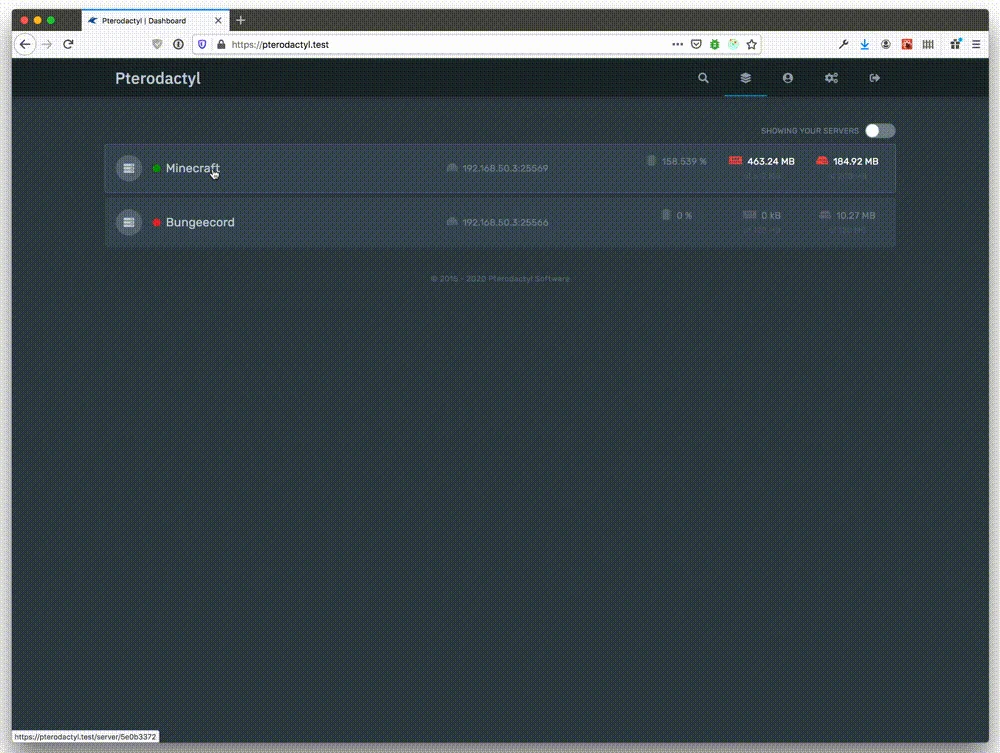
The Pterodactyl panel, listing the game servers of an account
Pterodactyl, from the project's README on GitHub (pterodactyl/panel, MIT licence).

Our servers are in Panama City and answer to Panamanian law. A US DMCA notice has no legal effect here, and we act only on valid orders from competent Panamanian authorities.

03/07

Requirements and sizing.

Wings needs a Linux machine that can run Docker, which rules out OpenVZ and LXC containers and is a non-issue on bare metal; both projects list Debian 13 as supported. The panel is a PHP application with MariaDB and Redis behind it and needs very little. Put it on a small cloud VPS rather than on the node, so that rebooting the node for a kernel update does not also take down your customers' login page and your billing.

The node is where the money is made, and sizing it is mostly a question of memory, because memory is what you sell. This is what a reseller node worth the effort looks like:

ResourceTargetWhy it matters for reselling
CPU24 coresMost small servers are idle most of the day, so cores let you pack them; clock speed decides how heavy modpacks behave
RAM192 GBThe unit you price by, and the one thing you must not oversell
IPv4A pool, not one addressLimits what a null-route takes down; Bedrock and other titles without SRV support need default ports
Uplink25 GbpsAttack headroom; players need far less
StorageNVMe, game data on its own partitionA full root filesystem takes the whole node down

Clock speed deserves more than a table cell. A Minecraft Java server still runs its world tick on one main thread, and the Minecraft Wiki notes that Bedrock Dedicated Server performs poorly on many-core server CPUs with low clocks. A 24-core node at a modest clock is very good for forty small survival servers and mediocre for one 300-mod pack with sixty players online. Sell heavy packs from a separate, higher-clocked machine, or price them high enough to pay for one.

On 192 GB, a theoretical packing works out like this: reserve about 8 GB for Debian, Docker and Wings, which leaves 184 GB, or 46 servers at 4 GB, or 23 at 8 GB. In the first case each server gets about half a core on average, which is fine because players are rarely all online at once. It stops being fine the moment you oversell memory as well: when the host runs out, the kernel's OOM killer picks a container and your customer sees a crash rather than a slowdown. Overcommit CPU a little if you must, and memory not at all.

Bandwidth is rarely the constraint people expect. The Minecraft Wiki puts Bedrock at about 5 Mbps of upload per ten players, so 1,000 concurrent players on one node would need roughly 500 Mbps (theoretical). A port many times that size is there to absorb attack traffic, and players will never come close to filling it.

Why the address pool matters more than the core count

Minecraft Java Edition looks up _minecraft._tcp SRV records and has done since version 1.3.1, so Java customers can share one IP on different ports and still give players a clean name like play.example.com. Bedrock Dedicated Server does not support SRV at all, so a Bedrock customer who wants players to type a bare address needs an IPv4 of their own on UDP 19132. The pool also limits the blast radius of an attack. If an address is null-routed anywhere along the path, only the servers allocated on it go dark, so put the attack magnets (large PvP and anarchy servers) on their own addresses and keep quiet customers together elsewhere.

04/07

Latency from
Panama City.

Panama sits between the two halves of the region, which helps only if the traffic actually takes the short way. The figures below are a theoretical floor: great-circle distance from Panama City, light in fibre at about 200,000 km/s, there and back. Real round trips are always longer, because cables do not follow great circles.

CityGreat-circle distanceTheoretical minimum RTT
Bogotá~770 km~8 ms
Guatemala City~1,350 km~14 ms
Miami~1,870 km~19 ms
Lima~2,360 km~24 ms
Mexico City~2,410 km~24 ms
Santiago~4,810 km~48 ms
São Paulo~5,090 km~51 ms
Buenos Aires~5,330 km~53 ms

The catch is routing. Some networks in the region still exchange traffic in Miami rather than locally, and a player in São Paulo whose ISP does that reaches PTY1 by way of Florida: about 8,440 km of path and a floor near 84 ms (theoretical), worse than a server in Miami itself. If your customers are almost all Brazilian, rent in São Paulo. Panama makes sense when your market is Central America, Colombia, Ecuador and Peru, or a Spanish-speaking community spread across the region that one node has to serve. Ask a few players to run mtr to the node before you sell slots to their friends.

05/07

How to deploy it
with us.

  1. 01Order Chrome with Debian 13. Sign-up is no-KYC: an email address is enough (see how no-KYC sign-up works), and we accept crypto, from business customers as well as individuals.
  2. 02Install the panel on its separate VPS following the Pterodactyl or Pelican panel guide, with a DNS name and a TLS certificate. Wings will need a certificate for the node's own name too.
  3. 03On the node, run uname -r first. Both projects warn against some hosts' modified kernels (names ending in -grs-ipv6-64 or -mod-std-ipv6-64); the stock Debian kernel is what you want, and because Debian 13's kernel is newer than 6.1, the old swapaccount=1 GRUB step in many guides is unnecessary. Mount a separate partition at /var/lib/pterodactyl before any customer data lands there. Then:
sh
# Debian 13, as root curl -sSL https://get.docker.com/ | CHANNEL=stable sh systemctl enable --now docker mkdir -p /etc/pterodactyl curl -L -o /usr/local/bin/wings "https://github.com/pterodactyl/wings/releases/latest/download/wings_linux_$([[ "$(uname -m)" == "x86_64" ]] && echo "amd64" || echo "arm64")" chmod u+x /usr/local/bin/wings # create the node in the panel, then paste its Configuration tab into /etc/pterodactyl/config.yml wings --debug # confirm a clean start, then Ctrl-C # install wings.service from the Wings documentation, then: systemctl enable --now wings

Pelican follows the same pattern with /etc/pelican and its own Wings build; use its install page rather than mixing the two.

  1. 04Open the firewall deliberately. By default Wings listens on 8080 for its API and on 2022 for SFTP. The live console in your customers' browsers talks to Wings directly, not through the panel, so 8080 (or 443 if you put a proxy in front of Wings) has to be reachable from the internet, not only from the panel. Then open the game port ranges you intend to allocate, TCP or UDP as each game requires.
  2. 05Add allocations. In Pterodactyl's terms an allocation is an IP and port pair, and every server needs at least one. This table is also how you will later work out which customer sits behind an address when a complaint arrives.
  3. 06Move backups off the node. The default driver writes archives to the node itself, so one dead disk takes a server and its backups together. Setting APP_BACKUP_DRIVER=s3, with your endpoint and keys, in the panel's .env sends them to S3-compatible storage such as our object storage.
  4. 07Connect billing last, once a test server has been created, backed up and restored by hand.

06/07

Cost.

ItemPrice and terms
Chrome in PTY1109.99 USD per month
Additional IPv4$2 a month per address
Panel VPS, object storageSee current prices
PaymentCrypto accepted, business customers included; top-ups earn a bonus, and unused balance is refundable within 14 days

The arithmetic, all theoretical: 109.99 USD spread across 46 servers of 4 GB is 2.39 USD per server per month, before the panel VPS, extra addresses, backup storage and your own time. If you sell a 4 GB plan at 6 USD (an example, not a pricing recommendation), 19 paying customers cover the node, since 109.99 ÷ 6 = 18.3. Everything after that pays for support, which in game hosting is the larger cost: customers open tickets at midnight about plugins you have never heard of.

The honest limitation on our side is that PTY1 is one site. A single node there gives you no failover, and if you promise customers redundancy you need a second node in another facility and backups that do not depend on either.

07/07

Limits and acceptable
use.

You are our customer and your customers are yours, which makes what they run on your node your responsibility toward us. Whoever the end customer is, a reseller node may not carry booter or "stresser" services (some game communities sell them next to hosting), traffic aimed at other networks, spam, or content that is manifestly unlawful. Mining is allowed under our policy, though on capacity you resell you will want a rule of your own about it.

Copyright complaints are common in this trade: cracked server software, leaked premium plugins, pirated maps. A DMCA notice has no legal effect on servers in Panama. We forward copyright complaints to the customer, which here means you, and act on a decision of a competent Panamanian authority, or where the content is manifestly unlawful. You then pass the complaint to whichever of your customers holds that IP and port, which is why the allocation table has to stay accurate. To reach us, open a support ticket from the client panel.

Personal data is the other obligation. Your panel and billing hold customers' email addresses and payment records, and your logs hold players' IP addresses. Panama's Law 81 of 2019 on personal data protection, implemented by Executive Decree 285 of 2021, applies to processing done here. If you sell to customers in the EU, Panama has no EU adequacy decision, so that transfer needs appropriate safeguards such as the 2021 standard contractual clauses. These are your obligations toward your customers, and we cannot discharge them on your behalf.
Catalogue·Options

Every configuration, every option, every price.

Six dedicated servers, all with a 10 Gbps port and unmetered traffic. Add NVMe, memory, a faster port or more addresses when you order.

Six dedicated servers in stock at PTY1 · 10 Gbps unmetered on every one

ServerCPUCores / threadsMemoryStoragePort, trafficPriceOrder
IronEntry levelEPYC 4244P6 / 1232 GB DDR51 TB NVMe10 Gbps unmetered$64.99/moOrder Iron
SteelBalancedEPYC 4344P8 / 1664 GB DDR52 TB NVMe10 Gbps unmetered$84.99/moOrder Steel
CobaltHigh frequencyEPYC 4564P16 / 3296 GB DDR54 TB NVMe10 Gbps unmetered$139.99/moOrder Cobalt
TungstenLarge memoryEPYC 4584PX16 / 32128 GB DDR56 TB NVMe10 Gbps unmetered$164.99/moOrder Tungsten
TitanMaximum densityEPYC 925424 / 48192 GB DDR58 TB NVMe10 Gbps unmetered$219.99/moOrder Titan

NVMe can be added in 2 TB steps up to 12 TB.

Every plan

  • 10 Gbps port25 Gbps for $25 more
  • Unmetered trafficfair use, no per-TB bill
  • DDoS protectionalways on
  • 1 IPv4 addressmore at $2 each
  • KVM consoleand full root access

Options and upgrades · prices per month

OptionWhat you getPrice
Extra NVMe2 TB per step, up to 12 TB on one server+$10.00
More memory32 GB per step, up to 192 GB+$12.00
25 Gbps portInstead of the included 10 Gbps, traffic still unmetered+$25.00
Extra IPv4Per address, to split sites or services+$2.00
Backup space1, 2, 5 or 8 TB$5 to $40
Priority supportPer server+$10.00
Object storageS3 buckets for libraries beyond 12 TB, unlimited traffic$7.96 per TB
Longer billingPay quarterly or yearly−10% / −25%

FAQ

Questions
people ask first.

Short answers about running this in PTY1. If yours is not here, open a ticket from your panel.

Still unsure?

Tickets go straight to the people who run PTY1.

Contact support
Can the panel and Wings run on the same Chrome?

Yes, and plenty of resellers start that way. The cost is coupling: every maintenance window on the node also takes down your panel and, if billing lives there too, your ability to take payments. A small separate VPS removes that dependency for the price of our smallest cloud plan.

Pterodactyl or Pelican?

Decide by your billing module first. Many WHMCS and Paymenter modules were written against Pterodactyl's API, so confirm that the one you plan to use supports Pelican before you commit. Beyond that, Pterodactyl 1.x has the longest track record and the largest body of community guides, and with 2.0 in open beta you should expect a major upgrade during the life of the node. Pelican is younger and publishes its own comparison page. Both list Debian 13 as supported for Wings.

What happens when one of my customers is attacked?

On your side, spread customers over several addresses, give attack-prone servers their own IP, and for a large Minecraft network put a Velocity or BungeeCord proxy in front so that only the proxy's address is public.

Does a server in Panama put my customers out of reach of US requests?

No host can promise that, and we do not. As of 31 October 2026 the US Department of Justice lists CLOUD Act executive agreements only with the United Kingdom and Australia, none with Panama. Panama and the United States are bound by a mutual legal assistance treaty in criminal matters, in force since 6 September 1995, which is the ordinary route for such requests. Under Article 29 of Panama's Constitution, private communications may be intercepted only on the order of a judicial authority. In practice a foreign request reaches us through Panamanian authorities, and we act on what they decide; the offshore hosting page covers this in more detail.

Can I sign up without ID and pay in crypto?

Yes. Our sign-up is no-KYC: an email address is enough, and we accept crypto from business customers as well as individuals. Top-ups earn a bonus, and unused balance is refundable within 14 days. Which identity checks you ask of your own customers is your decision, within the obligations set out above.

Sources

Every fact on this page, with its source

Consulted 2 Nov 2026 unless noted.

Your server in Panama,
ready when you are.

Cloud VPS start at $6.99 a month and are ready 60 to 120 seconds after you order.