Self-hosted app·Forms, surveys and feedback
Rallly hosting
on a VPS in Panama City.
Rallly hosting in PTY1, Panama City: the Docker stack on a 4 vCPU / 4 GB VPS for $12.99/mo, SMTP choices, licence tiers, backups and limits.
- Next.js
- PostgreSQL
- Traefik
- Docker
PTY1·Panama City
In stockRecommended for this use case
- 1 Gbps port15 TB of transfer a monthIncluded
- Debian 13preinstalled with the orderIncluded
- DDoS protection, 1 IPv4VNC console and full rootIncluded
Optional: daily backups +20% · extra IPv4 $2 · priority support $10
Pay yearly: $116.99 a year, about 25% less
- No KYC
- Crypto only
- Panama jurisdiction
- 4 vCPU, 4 GB RAM
- 160 GB NVMe local storage
- 15 TB transfer on a 1 Gbps port
- DDoS protection included
- Panamanian law
01/06
What Rallly is
and what you end up running.
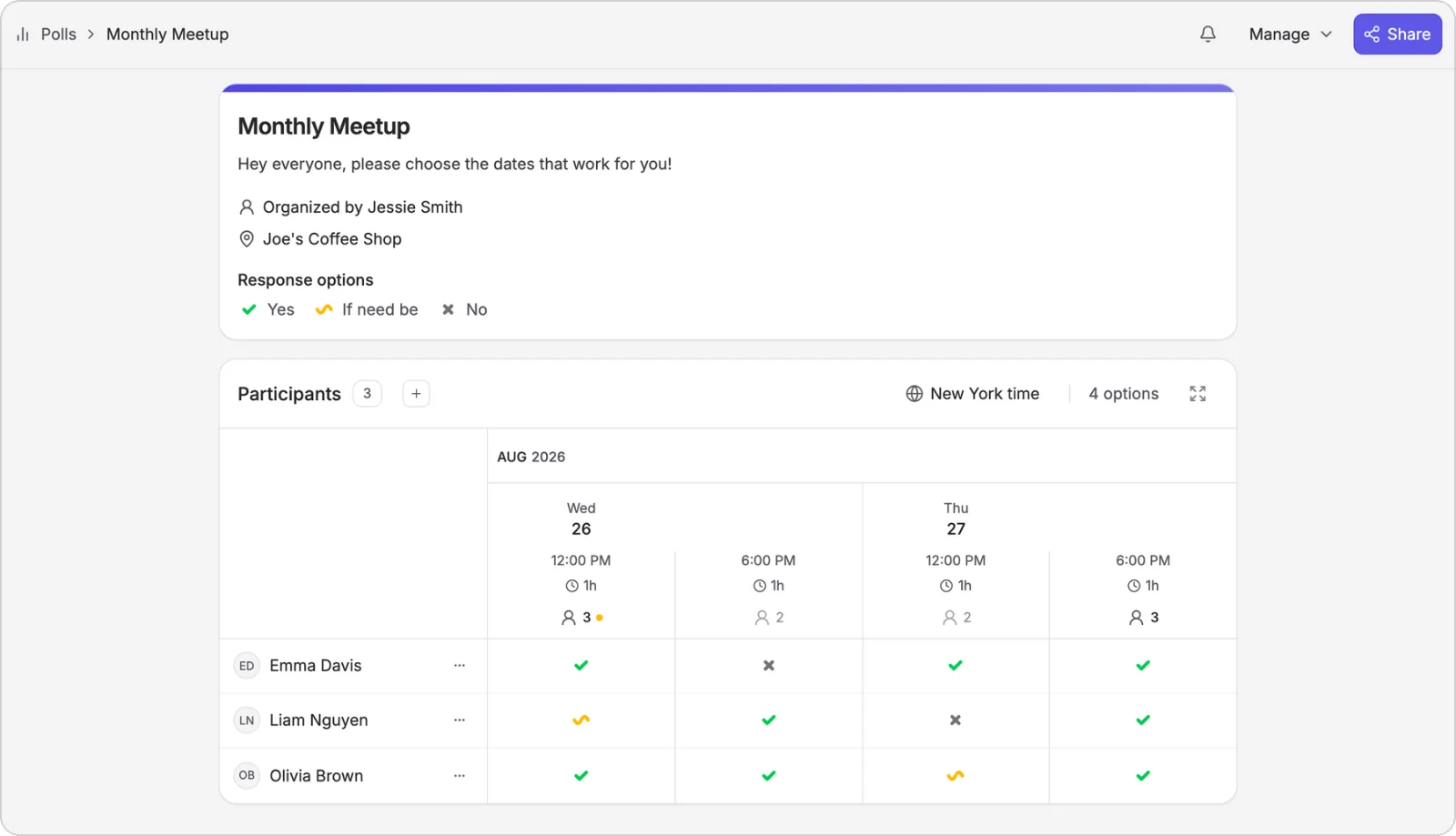
Rallly is an open-source tool for scheduling by poll. An organiser proposes dates and times and shares a link; participants mark the slots that suit them without creating an account, and the organiser picks one. Luke Vella writes and maintains it, in Next.js with Prisma and tRPC, under the AGPLv3, and runs a hosted version at rallly.co from the same codebase. The current release is v4.16.3, published on 26 October 2026. The 4.x series added shared workspaces called Spaces in 4.3.0, email invitations from the share dialog in 4.15.0 and video-conferencing links in 4.16.0.
Self-hosting now means the rallly-selfhosted repository and its management script, rallly.sh, rather than a Compose file you write yourself. The stack holds Traefik, which terminates TLS with a Let's Encrypt certificate; the Rallly web app; PostgreSQL, version 18 on a fresh install; and Garage, a small S3-compatible store for uploads such as avatars. Only Traefik binds host ports, on 80 and 443, and the other services stay on the Docker network. All configuration goes in .env, because ./rallly.sh update overwrites local edits to the Compose file.
The licence deserves a look before the hardware. Self-hosting is free for a single registered user. A team needs a key bought from Rallly: Plus covers up to 5 users for $49, Organization up to 50 for $499, and Enterprise starts at $999, each a one-time perpetual licence for the 4.x series. People who only vote never register and do not count, so one organiser polling a two-hundred-member association stays on the free tier. Activating a key requires the server to reach licensing.rallly.co over HTTPS.
02/06
Requirements and sizing.
Upstream asks for at least 2 GB of RAM, Docker 19.03 or newer with Compose v2, ports 80 and 443 free, a domain whose A record points at the server, and an SMTP server. It gives no CPU figure. On our Cloud VPS range that leaves three candidates:
| Plan | vCPU / RAM / NVMe | Transfer (1 Gbps port) | Price | For Rallly |
|---|---|---|---|---|
| Starter | 2 / 2 GB / 80 GB | 10 TB | $6.99/mo | Exactly the upstream floor: a trial, one user |
| Standard | 4 / 4 GB / 160 GB | 15 TB | $12.99/mo | Our recommendation |
| Pro | 6 / 8 GB / 320 GB | 20 TB | $22.99/mo | Only if Rallly shares the machine with other apps |
Starter meets the 2 GB figure and nothing more. That figure describes four containers in steady state; it does not cover ./rallly.sh update pulling a new web image while the old one is still serving, or ./rallly.sh upgrade-db, which dumps the database and restores it into a fresh PostgreSQL volume. Running short of memory halfway through a migration is the one failure in this stack that costs you an evening, and Standard removes that risk for six dollars a month more. Pro earns its price only if the VPS also runs other services behind your own reverse proxy.
Disk and transfer will not be the limit. A poll is a handful of database rows, and 160 GB holds the images, the dumps and years of polls. For transfer, a theoretical figure: if each poll view cost 2 MB including assets (an assumption, not a measurement), 15 TB would carry 7.5 million views a month. VPS traffic is not unmetered; the plan includes the 15 TB shown.
Our servers are in Panama City and answer to Panamanian law. A US DMCA notice has no legal effect here, and we act only on valid orders from competent Panamanian authorities.
03/06
Deploying Rallly
on Debian 13.
- 01
Order the VPS and point DNS
Order VPS Standard with Debian 13 from the deploy link. Create the A record for your hostname, say
meet.example.org, before you start the stack: Traefik requests the certificate on first boot, and Let's Encrypt cannot validate a name that does not yet resolve to the VPS. If you run a firewall on the server, allow inbound TCP 22, 80 and 443. - 02
Install Docker from Docker's repository
Debian's own
docker.iopackage trails Docker's releases and does not provide thedocker-compose-pluginpackage. Docker's repository supports Debian 13 (trixie) directly:apt-get update && apt-get install -y ca-certificates curl git openssl install -m 0755 -d /etc/apt/keyrings curl -fsSL https://download.docker.com/linux/debian/gpg -o /etc/apt/keyrings/docker.asc echo "deb [arch=$(dpkg --print-architecture) signed-by=/etc/apt/keyrings/docker.asc] \ https://download.docker.com/linux/debian trixie stable" > /etc/apt/sources.list.d/docker.list apt-get update apt-get install -y docker-ce docker-ce-cli containerd.io docker-buildx-plugin docker-compose-plugin docker compose version - 03
Fetch the stack and configure it
The upstream one-liner is
curl -fsSL https://get.rallly.co | bash. On a server that will hold other people's email addresses we prefer the manual route, which runs the same setup but lets you read the scripts first:git clone https://github.com/lukevella/rallly-selfhosted.git /opt/rallly cd /opt/rallly less install.sh rallly.sh # read them before running anything ./rallly.sh setupsetupasks for the domain, the support address and the SMTP details, then writes.envwith generated secrets: the session keySECRET_PASSWORD, the Postgres password and Garage's keys. Check these lines afterwards:DOMAIN=meet.example.org ACME_EMAIL=ops@example.org SUPPORT_EMAIL=help@example.org NOREPLY_EMAIL=noreply@example.org SMTP_HOST=smtp.your-relay.example SMTP_PORT=587 SMTP_SECURE=false SMTP_USER=rallly SMTP_PWD=change-me INITIAL_ADMIN_EMAIL=you@example.org ALLOWED_EMAILS=*@example.orgTwo details catch people out. Since 4.14.0 the server refuses to start if only one of
SMTP_USERandSMTP_PWDis set. AndSMTP_SECURE=falsebelongs with port 587 (STARTTLS),truewith port 465 (implicit TLS). - 04
Start, claim the admin role, close registration
Run
./rallly.sh start; Traefik normally has the certificate within a minute. Sign in with the address inINITIAL_ADMIN_EMAIL, open/control-paneland claim the admin role. Then decide who may register, before you share a single link. An open instance lets anyone create an account, and since 4.15.0 any account holder can send invitation emails to arbitrary addresses through your SMTP account, which makes it a spam relay carrying your domain. Restrict sign-ups withALLOWED_EMAILS, or setREGISTRATION_ENABLED=falseonce your team has its accounts, and apply the change with./rallly.sh restart. - 05
Keep it updated
The stack follows the
lukevella/rallly:4tag, so./rallly.sh updatebrings in the newest 4.x release. You can pin an exact version throughRALLLY_IMAGE, but a pin only helps if you keep moving it. Versions 4.8.0 to 4.15.3 shipped a Next.js release with a critical remote-code-execution flaw reachable through/api/og-image-poll, an endpoint that needs no sign-in; 4.15.4 fixed it on 6 October 2026. We would keep the major tag, take a backup, read the release notes and update by hand every week or two, because some releases migrate data: 4.15.0, for instance, purged soft-deleted responses for good. There is a local reason not to lag, too. Panama City keeps UTC−5 all year, so an organiser here polling people in Chicago or Toronto is exactly the case 4.16.3 fixed, where the browser's time zone and the poll's diverge around a clock change and a chosen slot was saved an hour late. - 06
Back up off the server
./rallly.sh backupwrites a timestamped.sql.gzinto./backups/. It covers the database only; uploads sit in thegarage-dataDocker volume (docker volume lsshows its full name), which you copy separately if you rely on them. A dump on the same VPS protects you from a bad migration and from nothing else, so ship it to a bucket. Our object storage starts at 250 GB for $1.99 a month, far more than a Rallly instance will produce. It is an S3 bucket reached with an endpoint and a pair of keys, so rclone or restic use it directly:# /root/.config/rclone/rclone.conf [pty1-s3] type = s3 provider = Other access_key_id = <from your panel> secret_access_key = <from the delivery ticket> endpoint = <endpoint shown in your panel># /etc/cron.d/rallly-backup 20 3 * * * root cd /opt/rallly && ./rallly.sh backup && rclone copy backups/ pty1-s3:rallly-backups/db --max-age 26h && find backups -name '*.sql.gz' -mtime +14 -deleteA restore follows the upstream procedure: stop the
webservice, drop and recreate theralllydatabase, stream the dump in withpsql -v ON_ERROR_STOP=1, start again. Rehearse it once on a scratch VPS before the day you need it.
04/06
The SMTP server decides
how private this is.
Hosting Rallly in Panama keeps polls, names and availability on a server you control. The mail path is where that control leaks. Every sign-in code and every notification passes through the SMTP server, which therefore sees each organiser's and participant's address and when they acted. Rallly's documentation recommends a transactional provider such as Resend, Postmark, Mailgun or Brevo, and advises against running your own because deliverability depends on IP reputation, SPF, DKIM, DMARC and reverse DNS; consumer mailboxes such as Gmail throttle automated senders and end up blocking sign-in mail. For most teams that advice is right, and its price is a third party holding your participant list under its own jurisdiction.
The alternative is real here because outbound port 25 is open on every VPS, so a Postfix on the same machine can hand mail straight to recipients' servers. That works well for a closed group on domains you control. For sign-in codes sent to strangers' Gmail and Outlook accounts from a fresh IPv4 with no sending history, expect the spam folder at first; our answer on running a mail server on Panama Host covers what it takes. A middle path is single sign-on through your own OIDC provider with EMAIL_LOGIN_ENABLED=false: organisers sign in without email, and only notifications still need a relay.
05/06
What it costs.
| Item | Price | Paid to |
|---|---|---|
| Cloud VPS Standard | $12.99/mo | Panama Host |
| Daily VPS backups (+20 %) | $2.60/mo (theoretical: 20 % of $12.99) | Panama Host |
| Object storage, 250 GB bucket | $1.99/mo | Panama Host |
| Rallly Personal, 1 user | Free | — |
| Rallly Plus, up to 5 users | $49, one time | Rallly |
| Rallly Organization, up to 50 users | $499, one time | Rallly |
| SMTP relay | The provider's own pricing | Third party |
The VPS price includes 1 IPv4 address, DDoS protection, full root and 15 TB of transfer on a 1 Gbps port. A theoretical first year for a team of five, billed yearly, with a backup bucket and a Plus key: $116.99 for the VPS on yearly billing, $23.88 for twelve months of storage and $49 to Rallly, so close to $190 in all, before whatever the SMTP relay charges. We take crypto only, with prices and balances in US dollars; a $100 top-up is credited as $110, and the unused paid part of a top-up is refundable within 14 days. The pricing page has the full terms.
06/06
Acceptable use
and your obligations.
A scheduling tool is an unremarkable workload, and a private Rallly instance will never trouble our abuse desk. The cases that do involve mail and deception. Using an open instance to send invitations to bought address lists is spam; a poll dressed up as a bank's or an employer's form to collect logins is phishing. Spam, phishing, fraud and malware are never hosted on our servers. Complaints about content we forward to the customer, and we act on a decision of a competent Panamanian authority, or where the content is manifestly unlawful.
The data in the instance is yours to answer for. Participants' names, email addresses, comments and availability are personal data, and as the operator you are their controller. Panama's Law 81 of 2019, implemented by Executive Decree 285 of 28 May 2021, governs that processing here. If participants are in the EU, Panama has no adequacy decision, so the transfer needs Article 46 safeguards, typically the 2021 standard contractual clauses, and arranging them falls to you as the exporter; our answer on whether an EU company can store personal data in Panama goes through it. Rallly's own terms bind you as well: its user limits run on an honour system that Rallly enforces, not us, and under the AGPLv3 a modified Rallly offered to users over a network must offer them its source. On our side, no-KYC: an email address is enough to open the account, as the no-KYC hosting page explains. Associations that need to reach decisions rather than dates may also want Decidim on a VPS.
Catalogue·Options
Every configuration, every option, every price.
Six cloud VPS plans on AMD EPYC with local NVMe. Transfer is included on every plan, from 10 TB to 100 TB a month.
| Plan | vCPU | Memory | NVMe | Transfer | Port | Price | Deploy |
|---|---|---|---|---|---|---|---|
| StarterStaging, dev | 2 | 2 GB | 80 GB | 10 TB / month | 1 Gbps | $6.99/mo | Deploy Starter |
| StandardRecommendedSmall apps | 4 | 4 GB | 160 GB | 15 TB / month | 1 Gbps | $12.99/mo | Deploy Standard |
| ProProduction | 6 | 8 GB | 320 GB | 20 TB / month | 1 Gbps | $22.99/mo | Deploy Pro |
| PowerHeavy workloads | 12 | 16 GB | 640 GB | 40 TB / month | 2 Gbps | $42.99/mo | Deploy Power |
| UltraDatabases | 16 | 32 GB | 1000 GB | 60 TB / month | 2 Gbps | $65.99/mo | Deploy Ultra |
| TitanDense hosts | 32 | 64 GB | 2000 GB | 100 TB / month | 5 Gbps | $119.99/mo | Deploy Titan |
Every plan runs on AMD EPYC with local NVMe. Yearly billing costs about 25% less.
Every plan
- AMD EPYCon every host
- Local NVMenot network storage
- DDoS protectionalways on
- 1 IPv4 addressmore at $2 each
- VNC consoleand full root access
FAQ
Questions
people ask first.
Short answers about running this in PTY1. If yours is not here, open a ticket from your panel.
Can I run Rallly on the $6.99 Starter VPS?
For a trial or a single organiser, yes: 2 vCPU and 2 GB meet Rallly's stated floor. It leaves no headroom for image pulls or the PostgreSQL upgrade, so for anything a team depends on we would take Standard. Moving later is a ./rallly.sh backup on the old server and a restore on the new one.
Do participants need accounts, and do they count towards the licence?
No to both. Guests answer a poll through its link without registering, and only registered accounts count towards the licence tier. Members invited to a Space do count, against both the instance limit and the Space's seats.
Can Rallly send its email directly from the VPS?
It can, because outbound port 25 is open on every Cloud VPS and Rallly accepts port 25 with SMTP_SECURE=false. Pointing it at a Postfix on the same host is the easy part. Getting sign-in codes into strangers' inboxes from a new IP address is the hard part, which is why Rallly recommends a transactional relay.
Can I run it behind my own Caddy or nginx next to other apps?
Yes. Set PROXY_MODE=external; Traefik is then skipped and the web container is published on 127.0.0.1:3000, the default for WEB_PORT. Keep that loopback bind: Docker publishes ports through its own iptables rules, which bypass ufw, so 0.0.0.0:3000 would expose plain HTTP to the internet. Have your proxy set X-Real-IP, because Rallly's in-memory rate limiting reads the visitor's address from that header.
Does hosting in Panama put my poll data out of reach of foreign authorities?
Not as a blanket matter, and a host that says otherwise is overselling. As of 31 October 2026 the US Department of Justice lists CLOUD Act executive agreements only with the United Kingdom and Australia, none with Panama, but the mutual legal assistance treaty in force since 6 September 1995 gives US prosecutors a route through Panamanian authorities. Article 29 of Panama's Constitution allows private communications to be intercepted only on a judicial order, and private documents to be examined only on a competent authority's order and for specific purposes. Law 51 of 2009 requires telecommunications companies and other communication networks to keep certain user data for six months; whether it applies to a hosting provider is a question for Panamanian counsel. Our offshore hosting page sets out the rest.
Can your object storage replace Garage as Rallly's upload store?
Yes. Set S3_ENDPOINT, S3_BUCKET_NAME, S3_REGION, S3_ACCESS_KEY_ID and S3_SECRET_ACCESS_KEY in .env to the values in your panel, and the bundled Garage container no longer starts. It is a bucket used through the S3 API, not a disk you attach to the VPS. For a few avatars we would keep Garage and use the bucket for backups.
Sources
Every fact on this page, with its source
Checked 5 Nov 2026 unless noted.
Panamanian law and authorities
- Law 81 of 26 March 2019, implemented by Executive Decree 285 of 28 May 2021Gaceta Oficial 28743-A · checked 31 Oct 2026
- Law 51 of 2009, art. 6, six-month retentionGaceta Oficial 26374 · checked 31 Oct 2026
- Constitution of Panama, art. 29G.O. 25176, Legispan · checked 31 Oct 2026
EU and other countries
- CLOUD Act executive agreements listed only with the United Kingdom and AustraliaUS Department of Justice · verified 31 Oct 2026
- No EU adequacy decision for Panama; Article 46 safeguards and the 2021 standard contractual clausesGDPR, Art. 46 · checked 31 Oct 2026
Industry, providers and software
- rallly-selfhosted README: architecture (Traefik, Rallly, PostgreSQL 18, Garage), only Traefik binds host ports, setup and upgrade-dbgithub.com/lukevella/rallly-selfhosted
- Rallly source repository: AGPLv3, Next.js, Prisma, tRPCgithub.com/lukevella/rallly
- Rallly v4.16.3, released 26 October 2026: time-zone fix around clock changesRelease notes
- Rallly v4.15.4, released 6 October 2026: critical RCE fix for /api/og-image-poll, affecting 4.8.0 to 4.15.3Release notes
- Rallly v4.15.0, released 9 September 2026: email invites, responses hard-deleted. Rallly v4.14.0, released 3 September 2026: SMTP_USER and SMTP_PWD required togetherReleases
- Docker Engine on Debian: Debian 13 (trixie) supported, docker-compose-plugin, ports published by Docker bypass ufwdocs.docker.com/engine/install/debian
Other references
- Rallly installation guide: requirements (2 GB RAM, Docker 19.03+ with Compose v2, ports 80/443, A record, SMTP), installer, external proxy, database and S3, advice against running your own SMTPsupport.rallly.co
- Rallly configuration reference: SMTP_ rules, EMAIL_LOGIN_ENABLED, REGISTRATION_ENABLED, ALLOWED_EMAILS, RALLLY_IMAGE, PROXY_MODE, WEB_PORT, RATE_LIMIT_ENABLED and X-Real-IP, S3 variablessupport.rallly.co
- Rallly management guide: rallly.sh commands, lukevella/rallly:4 tag, database-only backups, garage-data volume, restore proceduresupport.rallly.co
- Rallly licensing: tiers and prices, perpetual for 4.x, guests not counted, Space seats, honour system, activation via licensing.rallly.cosupport.rallly.co
- US–Panama mutual legal assistance treaty, signed 1991, in force 6 September 1995US Department of State · checked 31 Oct 2026
Your server in Panama,
ready when you are.
Cloud VPS start at $6.99 a month and are ready 60 to 120 seconds after you order.