Self-hosted app·Business software
EspoCRM hosting
on a VPS in Panama City.
EspoCRM hosting in Panama City: EspoCRM 10 on Docker, 4 vCPU / 4 GB VPS. Sizing, compose file, mail, backups and legal limits.
- PHP
- MariaDB
- Docker
- Caddy
PTY1·Panama City
In stockRecommended for this use case
- 1 Gbps port15 TB of transfer a monthIncluded
- Debian 13preinstalled with the orderIncluded
- DDoS protection, 1 IPv4VNC console and full rootIncluded
Optional: daily backups +20% · extra IPv4 $2 · priority support $10
Pay yearly: $116.99 a year, about 25% less
- No KYC
- Crypto only
- Panama jurisdiction
- 4 vCPU, 4 GB RAM
- 160 GB NVMe local storage
- 15 TB transfer on a 1 Gbps port
- DDoS protection included
- Panamanian law
01/06
Short answer.
Yes. EspoCRM runs on our Cloud VPS in PTY1, Panama City, and the plan we recommend for a production instance is VPS Standard: 4 vCPU, 4 GB RAM, 160 GB NVMe and 15 TB of monthly transfer for $12.99 a month. You install it yourself from the official Docker image (EspoCRM 10.0.11 at the time of writing, released on 23 October 2026) behind a reverse proxy that handles TLS. The detail that decides whether the install actually works is not CPU or RAM. EspoCRM is several cooperating processes, and the background daemon is the one people leave out: without it no scheduled job runs, so inbound mail is never fetched and campaign queues never move, while the web interface looks perfectly healthy.
02/06
What EspoCRM is
and who runs it.
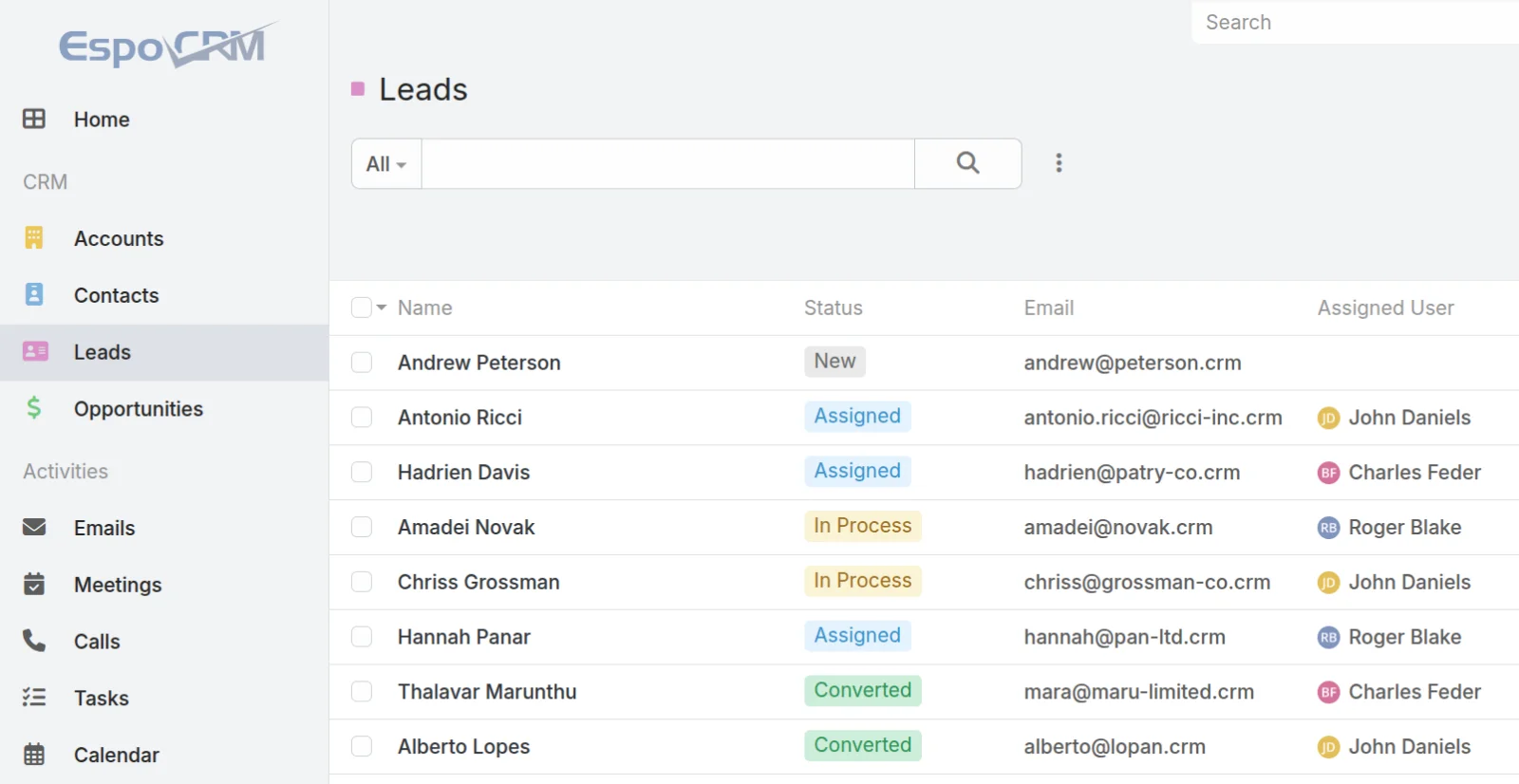
EspoCRM is an open-source CRM written in PHP, with a single-page JavaScript front end talking to its own REST API. The base package covers accounts, contacts, leads, opportunities, cases with a customer portal, a knowledge base and email campaigns. It is published under the AGPLv3, with a commercial licence for organisations that cannot accept copyleft terms; the same team sells a hosted cloud edition and paid extensions such as the Advanced Pack (reports, workflows, BPM) and the Sales Pack (quotes, invoices, inventory).
The people who self-host it tend to be small and mid-sized businesses that want a CRM without per-seat fees and with the database on a machine they control — a re-export firm in the Colón Free Zone tracking distributors across Central America is a typical shape. One licensing point deserves attention before you write code: the AGPL reaches users who interact with the software over a network, and the customer portal makes outsiders exactly that. If you patch EspoCRM's own code and expose it, read section 13 of the licence first.
Our servers are in Panama City and answer to Panamanian law. A US DMCA notice has no legal effect here, and we act only on valid orders from competent Panamanian authorities.
03/06
Requirements and sizing.
EspoCRM's server-configuration page sets the software floor at PHP 8.3 to 8.5 and MySQL 8.0+, MariaDB 10.6+ or PostgreSQL 15. (The download page still says MariaDB 10.3+; we follow the stricter, more detailed page.) It recommends php.ini minimums of memory_limit = 256M and 50 MB for uploads, and it advises a VPS or dedicated server rather than shared hosting for production. The Docker image bundles PHP and every required extension, so on a VPS most of this is decided for you; what remains is choosing a database image and sizing the machine.
EspoCRM publishes no hardware minimum, and we will not invent one. The official stack runs four containers: the web application (Apache and PHP), the daemon that executes scheduled jobs, an optional WebSocket server for live notifications, and MariaDB. The 256 MB memory_limit is a ceiling per request, not a reservation. MariaDB's default InnoDB buffer pool is 128 MB, which suits a small database and is the first setting to raise once list views start to drag. Disk grows with mail and files rather than with the application: emails fetched over IMAP are stored in the database, their attachments under data/upload.
| Plan | vCPU / RAM / NVMe | Transfer / port | Price | Our expectation for EspoCRM |
|---|---|---|---|---|
| VPS Starter | 2 / 2 GB / 80 GB | 10 TB / 1 Gbps | $6.99/mo | Evaluation and very small teams |
| VPS Standard | 4 / 4 GB / 160 GB | 15 TB / 1 Gbps | $12.99/mo | Recommended production starting point |
| VPS Pro | 6 / 8 GB / 320 GB | 20 TB / 1 Gbps | $22.99/mo | Advanced Pack workflows and reports, many synced mailboxes, large imports |
Transfer will not be the constraint. 15 TB a month is about 500 GB a day (theoretical), far beyond what a CRM moves unless the portal serves large documents. Inbound, you need 22, 80 and 443 and nothing else; outbound, 993 for IMAP and 587, 465 or 25 for SMTP.
04/06
How to deploy it
with us.
Order VPS Standard with Debian 13 from this deploy link, then point an A record such as crm.example.com at the VPS address. Install Docker Engine from Docker's own Debian repository rather than the distribution's packages, so the Compose plugin is current:
apt-get update && apt-get install -y ca-certificates curl
install -m 0755 -d /etc/apt/keyrings
curl -fsSL https://download.docker.com/linux/debian/gpg -o /etc/apt/keyrings/docker.asc
echo "deb [signed-by=/etc/apt/keyrings/docker.asc] https://download.docker.com/linux/debian $(. /etc/os-release && echo $VERSION_CODENAME) stable" \
  > /etc/apt/sources.list.d/docker.list
apt-get update && apt-get install -y docker-ce docker-ce-cli containerd.io docker-compose-plugin
EspoCRM also maintains an installer script (install.sh --ssl --letsencrypt --domain=… --email=…) that sets up Nginx, MariaDB and EspoCRM in containers under /var/www/espocrm. It works on Debian and is the fastest route. We prefer a Compose file you own, because the upstream examples pull :latest for every image and a CRM is the wrong place to discover a major version on a Tuesday morning. Here is the official Caddy layout, with pinned tags and secrets moved to a .env file:
services:
  caddy:
    image: caddy:2
    restart: unless-stopped
    ports: ["80:80", "443:443"]
    volumes:
      - ./Caddyfile:/etc/caddy/Caddyfile:ro
      - caddy-data:/data          # certificates; lose this and you re-issue on every rebuild

  espocrm-db:
    image: mariadb:11.8
    container_name: espocrm-db
    restart: unless-stopped
    environment:
      MARIADB_ROOT_PASSWORD: ${DB_ROOT_PASSWORD}
      MARIADB_DATABASE: espocrm
      MARIADB_USER: espocrm
      MARIADB_PASSWORD: ${DB_PASSWORD}
    volumes: [espocrm-db:/var/lib/mysql]
    healthcheck:
      test: ["CMD", "healthcheck.sh", "--connect", "--innodb_initialized"]
      interval: 20s
      start_period: 10s
      timeout: 10s
      retries: 3

  espocrm:
    image: espocrm/espocrm:10.0.11
    container_name: espocrm
    restart: unless-stopped
    environment:
      ESPOCRM_DATABASE_HOST: espocrm-db
      ESPOCRM_DATABASE_USER: espocrm
      ESPOCRM_DATABASE_PASSWORD: ${DB_PASSWORD}
      ESPOCRM_ADMIN_USERNAME: admin
      ESPOCRM_ADMIN_PASSWORD: ${ADMIN_PASSWORD}   # used at first install only
      ESPOCRM_SITE_URL: https://${DOMAIN}
    volumes:
      - espocrm-data:/var/www/html/data
      - espocrm-custom:/var/www/html/custom
      - espocrm-custom-client:/var/www/html/client/custom
    depends_on:
      espocrm-db: { condition: service_healthy }
    healthcheck:
      test: ["CMD", "bin/command", "app-check"]
      start_period: 20s
      interval: 60s
      timeout: 20s
      retries: 3
    expose: ["80"]

  espocrm-daemon:
    image: espocrm/espocrm:10.0.11
    restart: unless-stopped
    entrypoint: docker-daemon.sh
    volumes_from: [espocrm]
    depends_on:
      espocrm: { condition: service_healthy }

  espocrm-websocket:
    image: espocrm/espocrm:10.0.11
    restart: unless-stopped
    entrypoint: docker-websocket.sh
    environment:
      ESPOCRM_CONFIG_USE_WEB_SOCKET: "true"
      ESPOCRM_CONFIG_WEB_SOCKET_URL: wss://${DOMAIN}/ws
      ESPOCRM_CONFIG_WEB_SOCKET_ZERO_M_Q_SUBSCRIBER_DSN: "tcp://*:7777"
      ESPOCRM_CONFIG_WEB_SOCKET_ZERO_M_Q_SUBMISSION_DSN: "tcp://espocrm-websocket:7777"
    volumes_from: [espocrm]
    depends_on:
      espocrm: { condition: service_healthy }
    expose: ["8080"]

volumes:
  caddy-data:
  espocrm-db:
  espocrm-data:
  espocrm-custom:
  espocrm-custom-client:
The Caddyfile is two lines of routing; Caddy 2 passes the Host header through and sets X-Forwarded-* on its own:
crm.example.com {
    reverse_proxy /ws espocrm-websocket:8080
    reverse_proxy espocrm:80
}
Put DOMAIN, DB_PASSWORD, DB_ROOT_PASSWORD and ADMIN_PASSWORD in .env (generate each with openssl rand -base64 24), chmod 600 .env, then docker compose up -d and follow docker compose logs -f espocrm until the health check passes. Log in, change the admin password, and turn on two-factor authentication for every administrator. Notice what the file does not do: it publishes nothing except 80 and 443. The upstream example maps 8080:80 and 8081:8080, and Docker opens published ports through its own iptables chains, which a ufw policy on the host does not filter. Copy those lines and your WebSocket server sits on the public address.
- 01
Mail: port 25, IMAP and deliverability
EspoCRM does not deliver mail itself. It hands outgoing messages to an SMTP server you configure, system-wide or per user, and pulls inbound mail over IMAP. Outbound port 25 is open on every VPS we sell, so you can run your own MTA on the same machine or a second one. That puts deliverability on you: a fresh IPv4 needs a matching PTR record plus SPF, DKIM and DMARC before large providers accept campaign volumes from it.
- 02
Attachments on object storage
EspoCRM ships with an S3 storage driver, and since version 8.1 it accepts a non-AWS endpoint, which makes our S3-compatible object storage a natural home for
data/uploadonce attachments outgrow the VPS disk. Set this indata/config-internal.php(reach it withdocker exec -it espocrm bash), then'defaultFileStorage' => 'AwsS3'and'thumbImageCacheDisabled' => trueindata/config.php:'awsS3Storage' => [ 'bucketName' => 'espocrm-attachments', 'path' => 'upload', 'endpoint' => 'https://S3_ENDPOINT_FROM_YOUR_PANEL', 'pathStyleEndpoint' => true, 'region' => 'REGION', 'credentials' => ['key' => 'ACCESS_KEY', 'secret' => 'SECRET_KEY'], ],Use the driver, not
rclone mount: a FUSE mount under an application's live data directory is a reliable way to corrupt it. - 03
Backups and upgrades
Daily VPS backups protect you from losing the machine, but an image taken while MariaDB is writing is crash-consistent at best. The copy you restore from should be a logical dump plus the three EspoCRM volumes, pushed off the server:
docker exec espocrm-db sh -c 'mariadb-dump --single-transaction -uespocrm -p"$MARIADB_PASSWORD" espocrm' \
  | gzip > /var/backups/espocrm/db-$(date +%F).sql.gz
docker run --rm --volumes-from espocrm -v /var/backups/espocrm:/backup alpine \
  tar czf /backup/files-$(date +%F).tar.gz /var/www/html/data /var/www/html/custom /var/www/html/client/custom
Ship that directory to a bucket with restic and test a restore once, before you need it. Upgrading is then a dump, a tag change in the Compose file,
docker compose pull && docker compose up -d, and a look at the logs. If you are moving a 9.x install whose Compose file mounted the whole of/var/www/html, EspoCRM 10 requires a one-time migration to the separatedata,customandclient/custommounts; the upstream documentation has the exact commands.
05/06
What it costs.
EspoCRM itself is free; paid extensions are bought from EspoCRM, not from us. Our side of the bill for a sensible production setup:
| Item | Per month |
|---|---|
| VPS Standard (4 vCPU / 4 GB / 160 GB NVMe / 15 TB) | $12.99 |
| Daily backups (+20 % of the plan) | $2.60 |
| Object storage, 250 GB, for off-server dumps and attachments | $1.99 |
| Total | $17.58 |
The backup and total lines are calculations from the catalogue (theoretical). Yearly billing takes roughly 25 % off the VPS, $116.99 a year instead of $155.88; an extra IPv4 is $2/month. Payment is in crypto only (BTC, ETH, XMR, USDT, USDC and seven others), with prices in US dollars; top-ups of $25 to $5,000 earn a bonus of 5 % from $50 up to 20 % from $500, and the unused paid part is refundable within 14 days. Companies paying in crypto are welcome, and the account is no-KYC: an email address is enough. Full figures are on the pricing page. If the CRM ends up sharing a box with several heavier services, a dedicated Iron server (EPYC 4244P, 32 GB, $64.99) is the next step; EspoCRM on its own rarely justifies one.
06/06
Jurisdiction,
limits and your obligations.
A CRM is a file of other people's personal data, so the jurisdiction questions are yours as much as ours. Panama's Constitution (article 29) allows private communications to be intercepted only on a judicial order and private documents to be examined only on the order of a competent authority for specific purposes. As of 31 October 2026 the US Department of Justice lists CLOUD Act executive agreements only with the United Kingdom and Australia, none with Panama. That is not immunity: Panama and the United States have had a mutual legal assistance treaty in criminal matters in force since 6 September 1995, and requests under it reach us through Panamanian authorities. Whether the six-month retention duty in Law 51 of 2009 applies to a hosting provider is a question for Panamanian counsel. The longer version is on our offshore hosting page.
You are the data controller for what EspoCRM holds. Panama's data protection law is Law 81 of 2019, implemented by Executive Decree 285 of 2021. If you store personal data of people in the EU, Panama has no EU adequacy decision, so the transfer needs safeguards such as the 2021 standard contractual clauses. Compliance teams sometimes ask about lists: the FATF removed Panama from increased monitoring in October 2023, Panama has been off the EU's high-risk list for money laundering since 5 August 2025, and on 9 October 2026 the EU Council moved it from Annex I to Annex II of its tax list, pending a new OECD Global Forum review.
What is not allowed: campaigns to bought or scraped address lists or any other unsolicited bulk mail, data obtained by phishing or breaches, and portals that impersonate another organisation. Keep the opt-out link in EspoCRM's mass email on, and keep EspoCRM, MariaDB and Debian patched; the VPS is unmanaged, so everything inside the VM is yours. A DMCA notice has no legal effect on servers in Panama. We forward copyright complaints to the customer and act on a decision of a competent Panamanian authority, or where the content is manifestly unlawful.
Catalogue·Options
Every configuration, every option, every price.
Six cloud VPS plans on AMD EPYC with local NVMe. Transfer is included on every plan, from 10 TB to 100 TB a month.
| Plan | vCPU | Memory | NVMe | Transfer | Port | Price | Deploy |
|---|---|---|---|---|---|---|---|
| StarterStaging, dev | 2 | 2 GB | 80 GB | 10 TB / month | 1 Gbps | $6.99/mo | Deploy Starter |
| StandardRecommendedSmall apps | 4 | 4 GB | 160 GB | 15 TB / month | 1 Gbps | $12.99/mo | Deploy Standard |
| ProProduction | 6 | 8 GB | 320 GB | 20 TB / month | 1 Gbps | $22.99/mo | Deploy Pro |
| PowerHeavy workloads | 12 | 16 GB | 640 GB | 40 TB / month | 2 Gbps | $42.99/mo | Deploy Power |
| UltraDatabases | 16 | 32 GB | 1000 GB | 60 TB / month | 2 Gbps | $65.99/mo | Deploy Ultra |
| TitanDense hosts | 32 | 64 GB | 2000 GB | 100 TB / month | 5 Gbps | $119.99/mo | Deploy Titan |
Every plan runs on AMD EPYC with local NVMe. Yearly billing costs about 25% less.
Every plan
- AMD EPYCon every host
- Local NVMenot network storage
- DDoS protectionalways on
- 1 IPv4 addressmore at $2 each
- VNC consoleand full root access
FAQ
Questions
people ask first.
Short answers about running this in PTY1. If yours is not here, open a ticket from your panel.
Is the 2 GB Starter plan enough for EspoCRM?
For evaluating EspoCRM or a team of two or three, probably, though we have not measured where it starts to swap. Four containers including MariaDB on 2 GB leave little headroom for imports, reports and WebSocket connections, which is why Standard is our recommendation for production.
Do I need a cron job?
Not with Docker. The espocrm-daemon container runs scheduled jobs continuously and replaces the crontab entry. On a non-Docker install you add EspoCRM's one-line crontab entry, which runs cron.php every minute as the web server user.
Can I run it without Docker?
Yes. Debian 13 ships PHP 8.4 and MariaDB 11.8, both inside EspoCRM's supported ranges, so a classic Nginx or Apache install with PHP-FPM works. You then own PHP extensions, file permissions and the crontab yourself; Docker spares you those.
Can I use PostgreSQL instead of MariaDB?
EspoCRM supports PostgreSQL 15, and the Docker image accepts ESPOCRM_DATABASE_PLATFORM=Postgresql at first install. Every upstream example uses MariaDB, so it is the better-trodden path; pick PostgreSQL if your team already runs it.
Can I move an existing EspoCRM install to you?
Yes. Run the same EspoCRM version on both sides, restore the database dump and the data, custom and client/custom directories, set ESPOCRM_SITE_URL to the new address, and upgrade only once the move is confirmed working.
Sources
Every fact on this page, with its source
Panamanian law and authorities
- Constitution of Panama, article 29, G.O. 25176 (Legispan)s3-legispan.asamblea.gob.pa
- Law 81 of 26 March 2019 on personal data protection, Gaceta Oficial 28743-A (implemented by Executive Decree 285 of 28 May 2021)gacetaoficial.gob.pa
- Law 51 of 2009, article 6 (data retention), Gaceta Oficial 26374gacetaoficial.gob.pa
EU and other countries
- US Department of Justice, CLOUD Act resources — executive agreements with the UK and Australia onlyjustice.gov
- Council of the EU, update of the EU list of non-cooperative jurisdictions for tax purposes (9 October 2026)consilium.europa.eu
- Commission Delegated Regulation (EU) 2025/1184 — EU list of high-risk third countries, applicable 5 August 2025eur-lex.europa.eu
- GDPR, article 46 (appropriate safeguards)eur-lex.europa.eu
- Commission Implementing Decision (EU) 2021/914 — standard contractual clauseseur-lex.europa.eu
Other references
- EspoCRM, Download page — latest release 10.0.11 (23 October 2026), system requirements, installer scriptespocrm.com
- EspoCRM Documentation, Server configuration — PHP 8.3–8.5, MySQL 8.0+, MariaDB 10.6+, PostgreSQL 15, php.ini minimums, VPS recommendation, crontabdocs.espocrm.com
- EspoCRM Documentation, Installation with Docker — Compose services, volumes, upgrade, migration to EspoCRM 10, PostgreSQL platform variabledocs.espocrm.com
- EspoCRM Documentation, Caddy reverse proxy — Caddyfile and WebSocket pathdocs.espocrm.com
- EspoCRM Documentation, Installation by scriptdocs.espocrm.com
- EspoCRM Documentation, File storage — AWS S3 driver, non-AWS endpoint since 8.1, pathStyleEndpointdocs.espocrm.com
- EspoCRM Documentation, Backup and restore — Docker proceduredocs.espocrm.com
- US Department of State, Panama–US mutual legal assistance treaty, in force 6 September 1995state.gov
- FATF, Outcomes of the October 2023 plenary — Panama removed from increased monitoring (27 October 2023)fatf-gafi.org
Your server in Panama,
ready when you are.
Cloud VPS start at $6.99 a month and are ready 60 to 120 seconds after you order.